Monday, October 14

CHEMISTRY - BOHR'S MODEL & LEWIS STRUCTURE


What is the shell model?

The shell model of the atom describes the arrangement of electrons around the nucleus of an atom in terms of energy levels or shells.
The 13 electrons in an aluminum atom are arranged in three energy levels of 2.8.3

The nuclear model of the atom states an atom is composed of a positively charge nucleus which is orbited by negatively charged electrons.
The shell model of the atom describes how the electrons are arranged around the nucleus.
Three basics points will help you understand the arrangement of electrons around the nucleus of an atom.

  1. The Atomic Number (number of protons) = The number of electrons in an atom.
  2. The maximum number of electrons in the outer shell is eight
  3. The maximum number of electrons in the inner shells is 2n2 where n = the shell number

Shell number, n12345
Maximum number of electrons in shell, 2n228183250

The Atomic Number of an element can be found from any Periodic table.
For example the Atomic number of the element Bromine is 35. 

Bromine therefore has 35 protons and 35 electrons.

The electron configuration of bromine is 2.8.18.7 which means there are 2 electrons in the first shell, 8 electrons in the second shell, 18 electrons in the third shell and 7 electrons in the fourth shell. The total number of electrons is 35.


CHEMISTRY - PERIODIC TABLE - TRANSITION METALS #7

TRANSITION METALS

Transitioning

Transition metals in the periodic tableLet's start off by telling you that there are a lot of elements that are considered transition metals
Which metals are the transition metals? 

  • 21 (Scandium) through 29 (Copper)
  • 39 (Yttrium) through 47 (Silver)
  • 57 (Lanthanum) through 79 (Gold)
  • 89 (Actinium) and all higher numbers.

What Makes Them So Special?
It all has to do with their shells/orbitals
Transition metals are good examples of advanced shell and orbital ideas. 

  • They have a lot of electrons and distribute them in different ways. You will usually find that transition metals are shiny, too. Not all of them, but we are sure you've seen pictures of silver (Ag), gold (Au), and platinum (Pt). 


Number of electrons allowed in the orbitals of transition metals.Transition metals are able to put more than eight electrons in the shell that is one in from the outermost shell. Think about argon (Ar). It has 18 electrons set up in a 2-8-8 order. 
Scandium (Sc) is only 3 spots away with 21 electrons, but it has a configuration of 2-8-9-2. Wow! This is where it starts. This is the point in the periodic table where you can place more than 8 electrons in a shell. You need to remember that those electrons are added to the second-to-last shells. 

The transition metals are able to put up to 32 electrons in their second-to-last shell. Something like gold (Au), with an atomic number of 79, has an organization of 2-8-18-32-18-1. Of course, there are still some rules. No shell can have more than 32 electrons. You will find it's usually 2, 8, 18 or 32 for the maximum number of electrons in an orbital. 

One More Thing

Silver is a precious transition metal.Most elements can only use electrons from their outer orbital to bond with other elements. Transition metals can use the two outermost shells/orbitals to bond with other elements. It's a chemical trait that allows them to bond with many elements in a variety of shapes. 
Why can they do that? As you learn more, you will discover that most transition elements actually have two shells that are not happy. Whenever you have a shell that is not happy, the electrons want to bond with other elements. Example: Molybdenum (Mo), with 42 electrons. The configuration is 2-8-18-13-1. The shells with 13 and 1 are not happy. Those two orbitals can use the electrons to bond with other atoms. 

PHYSICS - ELEMENT of the DAY - CARBON

ELEMENT of the DAY - CARBON

Carbon is an element that has been known since ancient times. Carbon sometimes is considered the element of life, since all living cells and organic molecules contain carbon. Carbon takes the form of one the hardest elemental substances (diamond) and one of the softest (graphite). You encounter pure carbon as diamond, graphite in pencil 'lead', and amorphous carbon in soot and charcoal. The element is found in the food you eat, the clothes you wear and the air you breathe.  
Ten facts about Carbon:
  1. Carbon is the basis for organic chemistry, as it occurs in all living organisms.
  2. Carbon is a nonmetal that can bond with itself and many otherchemical elements, forming nearly ten million compounds.
  3. Elemental carbon can take the form of one of the hardest substances (diamond) or one of the softest (graphite).
  4. Carbon is made in the interiors of stars, though it was not produced in the Big Bang.
  5. Carbon compounds have limitless uses. In its elemental form, diamond is a gemstone and used for drilling/cutting; graphite is used in pencils, as a lubricant, and to protect against rust; while charcoal is used to remove toxins, tastes, and odors. The isotope Carbon-14 is used in radiocarbon dating.
  6. Carbon has the highest melting/sublimation point of the elements. The melting point of diamond is ~3550°C, with the sublimation point of carbon around 3800°C.
  7. Pure carbon exists free in nature and has been known since prehistoric time.
  8. The origin of the name 'carbon' comes from the Latin word carbo, for charcoal. The German and French words for charoal are similar.
  9. Pure carbon is considered non-toxic, although inhalation of fine particles, such as soot, can damage lung tissue.
  10. Carbon is the fourth most abundant element in the universe (hydrogen, helium, and oxygen are found in higher amounts, by mass).


ELEMENT of the DAY - OXYGEN

ELEMENT of the DAY - OXYGEN

Oxygen is an element you can't live without, although too much could make you sick or dead. Oxygen is in the air you breathe, the water you drink, most rocks and thousands of compounds. The element is inside of you and all around you. How much do you know about it?
Here are 10 interesting facts about the element oxygen
  1. Animals and plants require oxygen for respiration.
  2. Oxygen gas is colorless, odorless, and tasteless.
  3. Liquid and solid oxygen are pale blue.
  4. Oxygen is a non-metal.
  5. Oxygen gas normally is the divalent molecule O2. Ozone, O3, is another form of pure oxygen.
  6. Oxygen supports combustion.
  7. Oxygen is paramagnetic.
  8. Approximately 2/3 of the mass of the human body is oxygen.
  9. Excited oxygen is responsible for the bright red and yellow-green colors of the aurora.
  10. Oxygen was the atomic weight standard for the other elements until 1961 when it was replaced by carbon 12.

Friday, October 11

CHEMIISTRY - SUPERHEROES

You have received the information on SUPERHEROES ELEMENTS PROJECT

  • Check out the Periodic Table in pictures, it might help offer ideas as you choose your SUPERHERO.  

The following are sites to check out for superheroes or ideas for your project.

PERIODIC TABLE IN PICTURES

SUPER HEROES
\

COMIC SUPERHEROES
·         

Wednesday, October 9

CHEMISTRY - ATOM STRUCTURE MODULE #2

Atoms Are Building Blocks

Atoms are the basis of chemistry. They are the basis for everything in the Universe. You should start by remembering that matter is composed of atoms. 
Atoms and the study of atoms are a world unto themselves. 

We're going to cover basics like atomic structure and bonding between atoms. 
Smaller Than Atoms?
Even though super-tiny atomic particles exist, you only need to remember the three basic parts of an atom: electronsprotons, and neutrons
Structure of an atom with neutrons and protens in the nucleus and electrons in orbits

What are electrons, protons, and neutrons? A picture works best to show off the idea. You have a basic atom. 
There are three types of pieces in that atom: 
electrons, protons, and neutrons. As you know, there are almost 120 known elements in the periodic table. Chemists and physicists haven't stopped there. They are trying to make new ones in labs every day. 

The thing that makes each of those elements different is the number of electrons, protons, and neutrons
  • The protons and neutrons are always in the center of the atom. 
  • Scientists call the center region of the atom the nucleus
  • The nucleus in an atom is a place where you find protons and neutrons
  • The electrons are always found whizzing around the center in areas called shells or orbitals

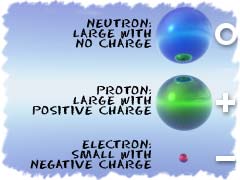
Protons carry a positive charge, neutrons carry a neutral charge, and electrons carry a negative charge.You can also see that each piece has either a 

"+",  "-",  or a "0." 

That symbol refers to the charge of the particle

Have you ever heard about getting a shock from a socket, static electricity, or lightning? Those are all different types of electric charges. Those charges are also found in tiny particles of matter. 

  • The electron always has a "-", or negative charge
  • The proton always has a "+", or positive charge
  • If the charge of an entire atom is "0", or neutral, there are equal numbers of positive and negative pieces. Neutral means there are equal numbers of electrons and protons. 
  • The third particle is the neutron. It has a neutral charge, also known as a charge of zero. 
  • All atoms have equal numbers of protons and electrons so that they are neutral. 
  • If there are more positive protons or negative electrons in an atom, you have a special atom called an ion


SCIENCE NEWS - PAINT GOES AIRBORNE #19

Although the idea of an aerosol spray back to the 18th century, Erik Rotheim was the first person to make a working device based on the concept. Tune in and learn how his Stuff of Genius has changed the world -- for better or worse -- in this episode.


Tuesday, October 8

SCIENCE NEWS - HANDWASHING DISHES IS THE WORST #18

Josephine Cochrane didn't exactly enjoy washing dishes -- then again, who does? Luckily, Mrs. Cochrane happened to enjoy design and a flair for invention. Learn more about her Stuff of Genius in this episode.

Stuff of Genius tells the story behind everyday inventions. From the bikini to super wheat and everything in between. Viewers will learn the stories of unsung inventor heroes and their trials, tribulations and successes.


Element of the Day - IRON

Element of the Day - IRON

Iron is one of the elements you can't live without. Each molecule of hemoglobin in your blood contains iron atoms, helping you transport oxygen throughout your body. Iron is the primary element in the steel girders that support many buildings and the stainless steel flatware you may have in your kitchen. The core of the Earth is predominantly iron. The element is abundant in the Earth's crust and the Sun. Pure iron is even softer than aluminum, but you encounter it after it has been hardened for any of a multitude of uses.
Iron is one of the elements you encounter in pure form. It is essential for nutrition and used in a variety of household objects. 
Here are some quick facts about iron
  1. Iron is an element that has been known in its pure form for at least 5,000 years. The name "iron" comes from the Anglo-Saxon word "iron" and Scandinavian "iarn" for the metal.
  2. The element symbol for iron is Fe, which comes from the Latin word for iron, "ferrum".
  3. Iron is one of the most plentiful elements. It comprises about 5.6% of the earth's crust and almost all of the earth's core.
  4. The single largest use of iron is to make steel, an alloy of iron and a smaller amount of carbon. According to achaeological records from Anatolia, man has been producing steel for at least 4,000 years.
  5. Iron is a transition metal.
  6. Iron is not always magnetic! The a allotrope (or form) or iron is ferromagnetic, yet if it is transformed to the b allotrope, the magnetism disappears even though the crystal lattice is unchanged.
  7. Animals and plants require iron. Plants use iron in chlorophyll, the pigment used in photosynthesis. Humans use iron in hemoglobin molecules in blood to allow for the transport of oxygen to tissues throughout the body.
  8. Although iron is an essential mineral, too much of it is extremely toxic. Free iron in the blood reacts with peroxides to form free radicals that damage DNA, protein, lipids and other cellular components, leading to illness and sometimes death. 20 milligrams of iron per kilogram of body weight is toxic, while 60 milligrams per kilogram is lethal.
  9. Iron primarily forms compounds with +2 and +3 oxidation states.
  10. Iron is formed via fusion in stars that have sufficient mass. The sun and many other stars contain significant amounts of iron.